Vetoes, majorities, and public preferences – Citizen attitudes toward decision-making in the European Union
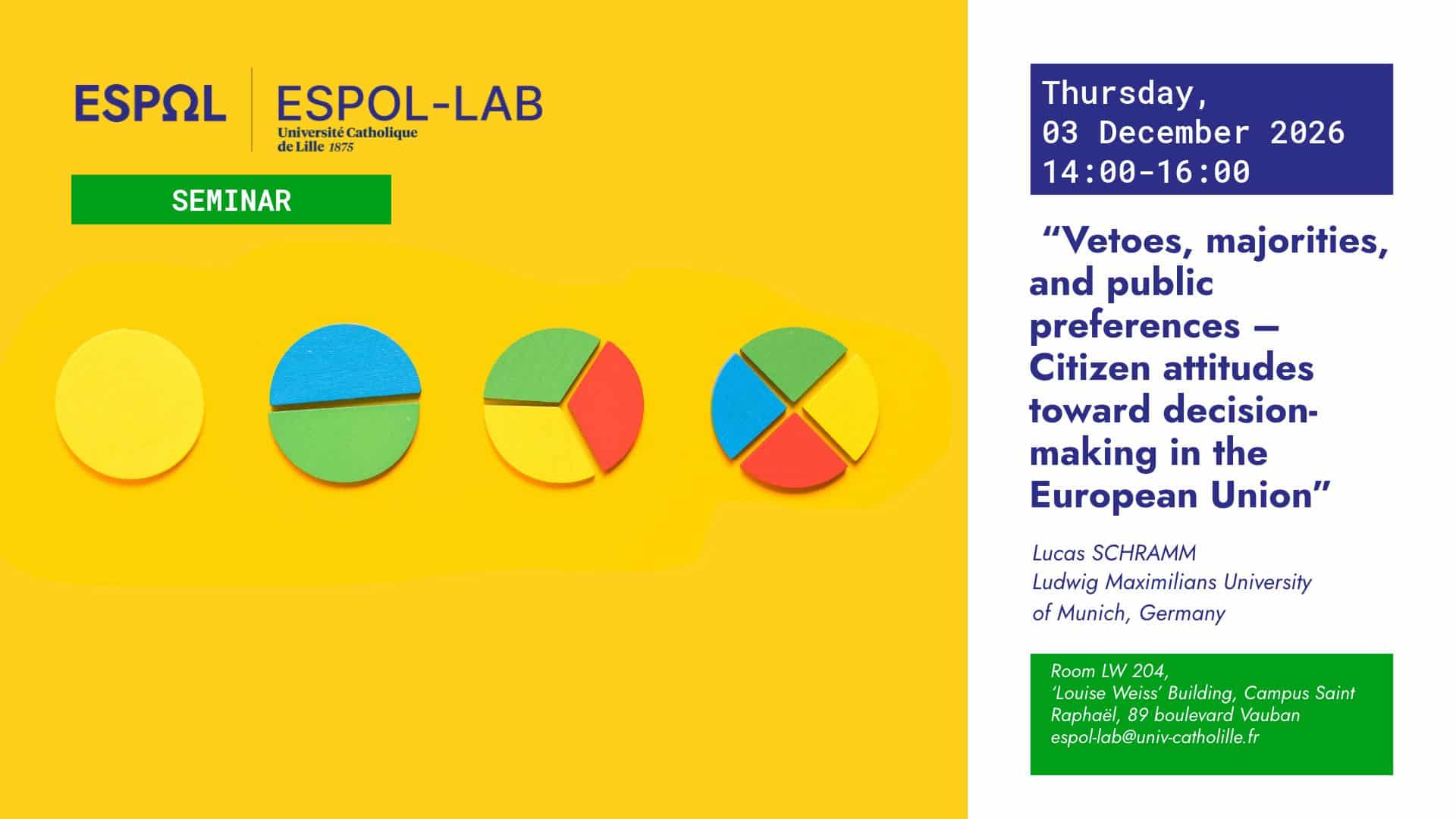
Vetoes, majorities, and public preferences – Citizen attitudes toward decision-making in the European Union
Le séminaire se tiendra en anglais.
Evénement réservé aux étudiants et au personnel de l’Université Catholique de Lille. Pas d’inscription nécessaire.
- Informations sur l’invité :
Dr. Lucas Schramm is a senior researcher and lecturer at Ludwig Maximilians University of Munich. Dr. Schramm’s research interests centre on European integration and European Union politics, with specific focus on Europe and Germany in comparative perspective and European institutions, in particular the European Council.
- Abstract du séminaire :
This paper examines citizens’ attitudes toward decision-making rules in the European Union (EU), focusing on the tension between national veto rights and collective problem-solving. While debates about unanimity and qualified majority voting have intensified in the context of war, enlargement, rule-of-law conflicts, and recurrent institutional blockages, public opinion research has paid limited attention to how citizens evaluate the procedural foundations of EU governance, particularly in the European Council. We address this gap with original survey-experimental evidence from Germany, Poland, Spain, and Sweden. Respondents received information about decision-making rules in the European Council and the Council of the EU (of Ministers), followed by randomized primes emphasizing either the sovereignty-protecting function of unanimity or its susceptibility to blockage. We then measure preferences over institutional decision rules, support for bypassing national vetoes in different scenarios, and attitudes toward unanimity across policy areas. The findings show that citizens hold differentiated procedural preferences. Support for majority voting is substantial in both intergovernmental bodies, but higher for the Council of Ministers than for the European Council. Anti-blockage information increases support for majority voting in the European Council, whereas sovereignty cues do not substantially strengthen support for unanimity. Citizens condition the legitimacy of veto circumvention on the conduct of the blocking government, with strongest support when vetoes are associated with misuse of EU funds or democratic backsliding. Finally, preferences vary by policy area: unanimity remains most strongly supported in defense, but much less so in company taxation, climate policy, and consumer protection. Overall, public support for decision-making based on majority voting in both EU institutions and EU policy areas is higher than the current treaty provisions suggest.

You may also like